NeighborhoodLowry Hill
A George Maher Mansion and the Prairie School on Lowry Hill
A 1910 Prairie School mansion designed by architect George W. Maher stands at 1324 Mount Curve Ave. on Lowry Hill, among a ridge of European revival houses.
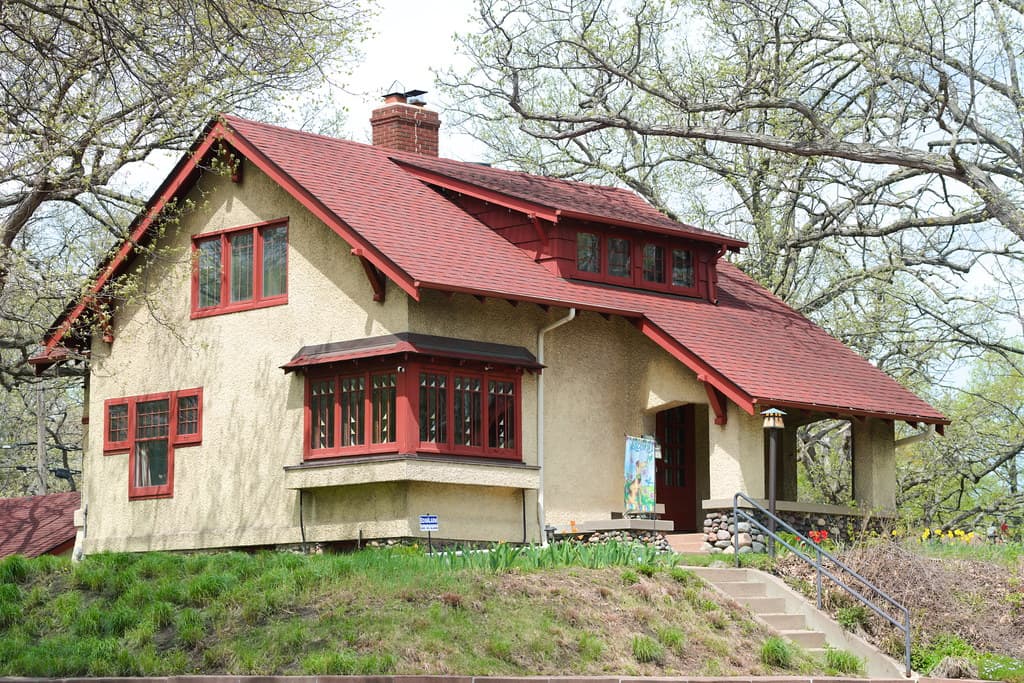
The roughly 10,900-square-foot house, with six bedrooms on a half-acre lot, was designed by George Washington Maher (1864-1926), an American architect counted among the Prairie School and a contemporary of Frank Lloyd Wright. It came on the market in recent years listed at $2.14 million, and a nearby 1910 Prairie School house on Mount Curve has listed for as much as $2.85 million (startribune.com/1910-prairie-school-home-on-mount-curve-in-minneapolis-lists-for-2-85-million/600181092).
Maher is known for what he called his Motif-Rhythm theory, repeating a single design element throughout a house; the poppy recurs in the home's leaded-glass windows, French doors and built-ins. Open, flowing rooms and large windows were his trademarks, and the listing describes original elements preserved through later renovation.
The house stands out on a ridge dominated by Renaissance Revival and Italian Renaissance mansions built for the city's milling and lumber barons. Its horizontal lines and midwestern modern sensibility mark a clear break from the European precedents next door.
That mix is part of what preservationists prize about Lowry Hill. Within a few blocks the neighborhood holds Renaissance Revival, Italian Renaissance, Arts and Crafts and Prairie School work, much of it built within a few years of one another in the first decade of the 20th century. Architecturally significant houses like Maher's tend to carry a premium that square footage alone does not explain, which gives owners an incentive to restore rather than remodel away the features that make them valuable.
NeighborhoodLowry Hill
Related stories
Neighborhood
Lowry Hill and East Isles Land on Patch's List of Minnesota's Most Expensive Neighborhoods
Lowry Hill and East Isles rank among Minnesota's most expensive neighborhoods according to Patch's analysis of Niche's 2026 data.

Neighborhood
Community celebrates Lake of the Isles Pencil's 5th sharpening
Thousands gathered in East Isles on June 6, 2026, to watch the annual ceremonial sharpening of Minneapolis' giant pencil sculpture.

Neighborhood
The end is in sight for Loring Park dandelion fountain's drought
State lawmakers approved $1.8 million for Berger Fountain repairs, and Park Board crews have begun demolition at the dry Loring Park landmark.
The neighborhood, in your inbox
Free. No paywall. Pick the topics you want — we send what’s happening this week.