OpinionLowry Hill
Oldenburg and Van Bruggen's Mark on Minneapolis Endures
The artists behind Spoonbridge shaped how a generation sees public sculpture.
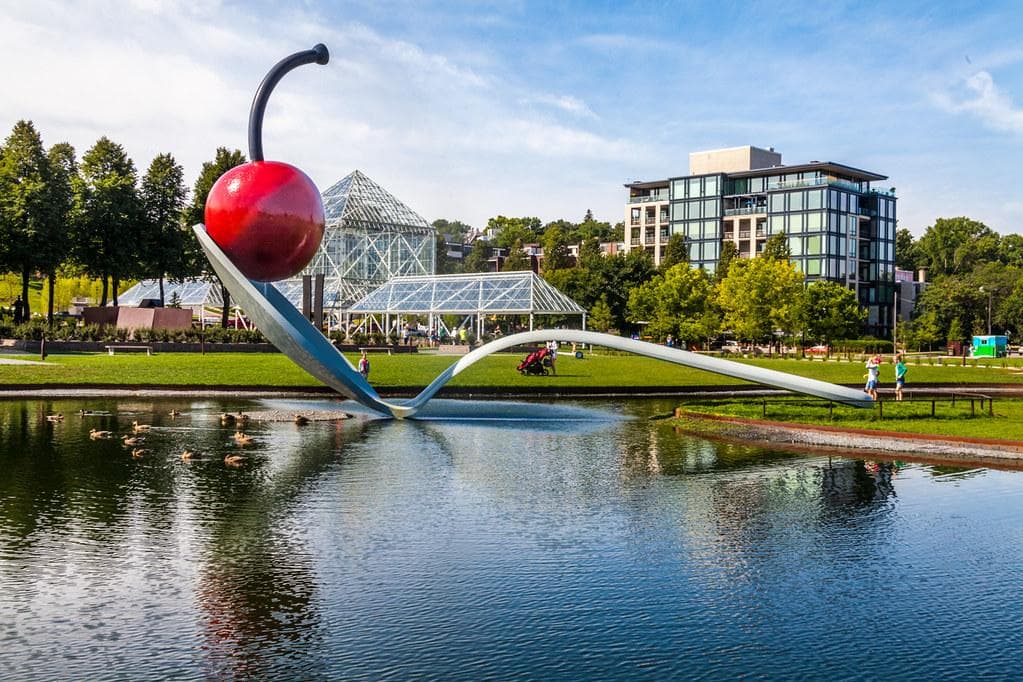
Claes Oldenburg and Coosje van Bruggen made a career of blowing everyday objects up to monumental scale - a clothespin, a trowel, a shuttlecock - and Minneapolis got one of their defining works. Spoonbridge and Cherry, anchored in the Minneapolis Sculpture Garden since 1988 and funded by a gift from art collector Frederick R. Weisman, remains the clearest local statement of the couple's shared vision.
It is also, by now, so familiar that it is easy to forget how odd and how radical the idea behind it actually is.
The ordinary, made monumental
Their genius was to take the most ordinary objects - a spoon, a cherry - and grant them the gravity of a war memorial. The joke and the grandeur coexist, and holding both at once is much harder to pull off than it looks and far easier to imitate badly. A giant spoon could be merely silly. Oldenburg and van Bruggen made it monumental without draining the wit out of it, so it reads as funny and serious in the same glance.
That balance was the whole project of their partnership. Van Bruggen, who named many of the works and shaped their wit and titles, and Oldenburg, who had spent decades enlarging the everyday, found in collaboration a way to make public sculpture that was grand and approachable at once - a combination most monuments never even attempt.
“They made the ordinary monumental, and taught a city that a monument could also be a joke.”
More than a photo opportunity
For Minneapolis, the partnership produced far more than a photo opportunity. It taught a city to expect humor and surprise from its public art, and to accept that a monument need not be solemn to be serious. A place that grows up with a beloved giant spoon in its most famous park is a place primed to welcome the playful and the strange - to assume, by default, that art in public is allowed to delight rather than only to commemorate.
That is a real cultural inheritance, not just a landmark. It lowers the bar for everything that comes after: the mural, the odd installation, the next big sculpture all land in a city that has already agreed art can be fun.
The work still teaching
Decades later, the work still does its quiet teaching. Children laugh at the giant spoon, then grow up assuming - correctly - that art is allowed to be playful. That lesson, absorbed early and without effort, may be the sculpture's most durable contribution: not the photographs it generates, but the expectations it sets in the people who grow up beside it.
Oldenburg died in 2022 and van Bruggen in 2009, but the work outlasts its makers in the most concrete way - standing free and open in a public park, doing the same job it has done since 1988. For Lowry Hill, that is the legacy: not a name on a plaque, but a spoon in the pond that keeps teaching new arrivals, one delighted child at a time, what art can be.
OpinionLowry Hill
Related stories

Opinion
Opinion: Practical Local Pages Deserve the Front Page
A neighborhood site earns trust when its calendar, directory and public-safety basics are easy to find every day.

Opinion
Letter: A Thank-You to the Hill's Quiet Institutions
A longtime resident thanks Kenwood Community School, the Lowry Hill Neighborhood Association and the neighborhood's volunteers.

Opinion
Letter: Keep the Lakes in the Conversation
A resident urges that the health of the lakes stay a standing item on neighborhood agendas, not an afterthought once school budgets and development are settled.
The neighborhood, in your inbox
Free. No paywall. Pick the topics you want — we send what’s happening this week.